

Deck Builder on the Long Beach Peninsula
Soft boards and a wobbly railing? Here is how to know what your deck actually needs.
You step onto your deck and feel it give a little. The railing moves when you lean on it. Maybe there is a dark patch around a post that was not there last year. Now you are stuck on the question every Peninsula homeowner eventually faces. Do you need a whole new deck, or can this one be saved?
That question is hard to answer from the surface, and it is exactly the wrong thing to guess at. A deck can look fine on top while the framing underneath quietly rots. Christensen Coastal Construction is the deck builder homeowners across the Long Beach Peninsula call for deck building, repair, and replacement, and we are based right here in Ocean Park. We will come look at yours, tell you straight whether it needs repairs or replacement, and put the number in writing before you commit to anything.
Want someone to just come look at it? Call (564) 544-4428 or fill out the contact form for a free quote.
Decks Built for Coastal Weather
Why Decks Fail Faster Out Here Than Anywhere Inland
A deck on the Peninsula does a harder job than a deck almost anywhere else. Salt air speeds up corrosion on fasteners and connectors. Steady moisture keeps wood damp long after the rain stops. Wind drives water into seams and gaps that an inland deck never has to deal with. Shade and damp let moss and algae take hold, and that traps even more moisture against the wood.
The biggest mistake is treating a coastal deck like a normal inland one. The framing you cannot see takes the worst of it. Posts, beams, and the ledger board where the deck attaches to the house are the first places rot shows up, and they are the last places a homeowner ever looks. That is why a deck that seems solid can fail at a connection point you never knew was weak.
None of this is bad luck. It is slow, predictable decay, and it is preventable when the deck is built and maintained for these conditions from the start.
Repair or Replace: How We Actually Decide
This is the question that keeps you up at night, so let me answer it honestly. The right call depends on the condition of the framing, the stairs, the railings, and the connection to the house. If the structure underneath is solid and the problems are on the surface, targeted repairs are usually enough. If rot or movement has spread through the framing, replacement is the safer long-term option.
We inspect both the boards you walk on and the structure below them. A deck can look acceptable from above while the support underneath is starting to go. We tell you what we find and what it means, and sometimes that means recommending repairs when a full rebuild would have been a more profitable sale for us. You should be suspicious of anyone who quotes a teardown before they have looked under the hood.
Targeted repair can often cover:
Soft, cracked, or loose deck boards
Stairs and landings that move or feel unstable
Damaged or wobbly railings
Rusted or failing fasteners and connectors
Rot-damaged framing where the damage is contained
Drainage problems are pushing water where it should not go
When the framing is too far gone, a full replacement is the cleaner investment. We remove the failing deck, inspect every connection point, and rebuild with corrosion-resistant hardware, proper flashing, and a layout that fits how you use the space now. It is also the moment to fix what bugged you about the old one, whether that is safer stairs, a sturdier railing, or a more usable room.
What We Build and Repair
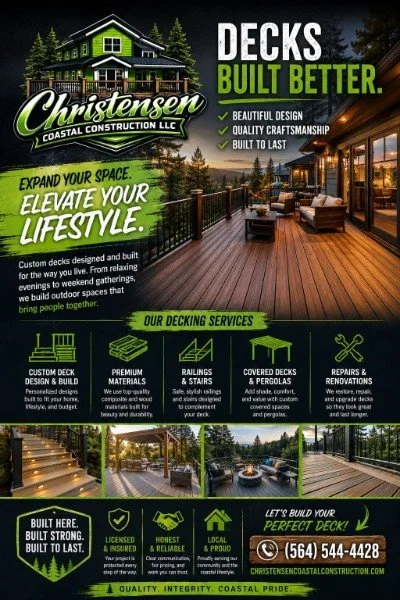
We handle new decks, repairs, replacements, and the safety details that get overlooked. New deck work covers backyard decks, entry landings, wraparound and raised decks, beach house and vacation rental decks, plus stairs and railing systems. Every new build starts with the real conditions of your property. We look at exposure, drainage, elevation, access, privacy, wind, and how you actually plan to use the space before we talk about size and materials.
Stairs and railings deserve their own mention because they are where safety issues first arise. If the rest of the deck is sound, we can often repair or replace just those without rebuilding everything. A railing that gives when someone leans on it is not a someday problem, especially with kids, older family members, or paying guests using the deck.
We also build low, dock-style platform decks that sit close to the ground for a clean, open look. Like any deck out here, they need corrosion-resistant hardware and proper detailing to withstand the coast, and we build them to handle it.
What Working With Us Looks Like
Site visit and inspection. We look at the structure, access, drainage, exposure, and how the deck connects to your home.
Design and material talk. We go through size, layout, stairs, railings, surface materials, upkeep, and budget.
Written estimate. You get a clear scope and price before any work starts. No guessing, no pressure.
Prep and demolition. We remove unsafe or failing materials and protect the rest of your property.
Build. Our own crew handles framing, decking, railings, stairs, and finish details for coastal conditions.
Cleanup and walkthrough. We clean up and walk you through exactly what was done.
We keep the process simple, and we keep you informed at each step. No disappearing after the estimate, no crew you never met showing up unannounced. Christensen Coastal Construction is a licensed and insured Washington State contractor, so the work is covered and accountable from start to finish.
Choosing Decking Material That Survives the Salt
Material choice matters more here than budget alone would suggest. Wood can cost less up front and still be the wrong call once you add years of coastal upkeep. We work with pressure-treated wood, cedar, composite, and PVC. Composite and PVC hold up to wet coastal conditions with the least fuss, which is why they suit rentals and homeowners who do not want a yearly maintenance project. Wood still works for plenty of homes. It just needs an owner who will keep up with it. We use the best material for your deck and its level of exposure, and we walk you through the trade-offs rather than pushing one product on everyone.
Catch It Early and Save Yourself a Teardown
A deck does not have to collapse to be unsafe, and waiting almost always costs more. The soft spot you feel today is the framing telling you water has been working on it. Left alone, a repair you could handle this season becomes a full replacement next year at several times the price. Worse, a railing that fails or a board that gives way puts someone you care about at risk.
Watch for these signs and get them looked at before they spread:
Soft or spongy boards underfoot
Railings that wobble or feel loose
Stairs that move, lean, or feel unstable
Boards pulling away from their fasteners
Rusted connectors or hardware
Rot around posts, beams, or the ledger board
Standing water or poor drainage under the deck
Moss or algae is making the surface slick
Gaps where the deck meets the house
If any of these sound like your deck, that is the moment to have someone look, not next spring.
Common Deck Questions
A few things Peninsula homeowners ask us most about when it comes to decks. Don’t see your question? Call (564) 544-4428 and just ask.
What's the best decking material for our salt air and constant moisture out here?
On the coast, the big enemies are salt, wind-driven rain, and decking that almost never fully dries out. Capped composite and PVC boards tend to hold up well because they don't absorb water, won't rot, and resist the gray weathering that hits wood hard near the ocean. If you prefer real wood, naturally durable options like cedar exist, but plan on more upkeep and a shorter lifespan in this climate.
Should I repair my deck or just replace it?
It usually comes down to the framing underneath, not the boards you can see. If the joists, beams, and posts are solid and only surface boards or railings are worn, a repair or reboard makes sense. Once you find soft, spongy, or rotting structural wood, especially near the ground or at connection points, a full replacement is often the safer, smarter long-term call.
How long should a deck last in a coastal climate like the Long Beach Peninsula?
Lifespan depends heavily on material and upkeep, and the coast is tougher on decks than most inland areas. A well-built composite or PVC deck can last for decades with minimal maintenance, while a wood deck out here often needs more frequent attention and may not last as long without diligent sealing. Good framing, proper fasteners, and drainage matter just as much as the surface material when it comes to how long it holds up.
Composite or wood, which one makes more sense here?
Wood costs less up front and gives you that natural look, but in salt air and steady moisture, it needs regular cleaning, sealing, and board replacement to stay safe and looking good. Composite costs more at the start, yet resists rot, splintering, and fading, and it usually needs little more than an occasional wash. For a low-maintenance deck near the ocean, many homeowners lean toward composite, while wood still appeals to folks who don't mind the upkeep.
Do I need a permit to build a deck in Pacific County?
In most cases, yes, especially for decks attached to the house or raised more than a low height above the ground. Pacific County generally requires a building permit so the structure meets code for footings, framing, and railings, and coastal zones can add floodplain or shoreline rules on top of that. The simplest move is to confirm with the county's community development office before you start, since requirements vary by location and deck size.
How do I know a deck builder is properly licensed?
In Washington, contractors are required to register with the Department of Labor and Industries, which means they must be bonded and insured. You can verify any contractor's license, bond, and history for free using the L&I online verification tool before you sign anything. It's also smart to get a written contract, check references, and make sure the bond and insurance are active, which protects you if something goes wrong.
Deck Areas We Serve
We build and repair decks across the Long Beach Peninsula and nearby Pacific County, including Ocean Park, Long Beach, Ilwaco, Seaview, Naselle, and Chinook. Not sure if we reach your property? Call and ask. If we can get there, we will help.